Thursday, October 11, 2007

Brad visits Korea


Having someone from home visit I think helps validate the life you're living in a foreign country. Suddenly there is a connection between the life you knew and the life you're living that makes the two seem a bit more mentally compatible. I haven't experienced culture shock here and don't think I will, nor do I think that I'll have a huge problem adjusting to life back in the states (Although, I am really worried that the Korean habit of not flushing toilet paper down the toilet -- instead throwing it in a trashcan next to the toilet -- will stay with me in America. I can see myself now: thinking there is a trashcan next to me and then throwing toilet paper all over the floor. I can just imagine the bad assumptions people would have about Korean hygiene!). It is nice though to have someone familiar visit and know what you're talking about when you are describing where you work and live, who you live with, and what you are doing day in and day out.

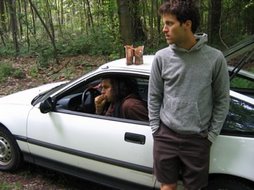
My old roommate Brad visited over the weekend and now is that connection between home and here. After work last Thursday I took a train filled with old drunken men (on this ride at least alcohol + train + old Korean men = lots of random fights with the train staff) to nearby Cheonan station, where the high-speed KTX trains connect the north-end of the penninsula at Seoul to the South-end at the port city of Busan. From there I was locked out of my KTX train with 12 other Koreans and had to deal with an hour of prolonged arguments that eventually led to a partial reimbursement, lots of apologies about how this had never happened before, and a new ticket on the next train. An hour and a half late into Busan, I met Brad, who was worn from over 12 hours of traveling from Naruta Japan, where he works as a english teacher through the JET program. The next three hours we took cabs half-way across the city to a jjimjilbang that turned out to be closed and ended the night on a good note, by finding a hot spring motel that had a bathroom bigger than the bedroom (that's not to say that the bedroom was small, the bathroom was just HUGE and had multiple bath tubs).

The next day we gradually made our way to the Busan Film festival -- asia's largest -- and met up with other F-brighters in what turned out to be a huge reunion with almost everyone that had come over on the program. In all, Brad and I caught two movies because of the difficulty for foreigners without a foreigner id number (i don't have one because i am here on a diplomatic visa) to get tickets and the long lines to get them otherwise. Noteworthy was The Naked Summer by Kenji Okabe. The movie documents a summer camp run by Butoh dance master Okaji Maro and the creation of one of Okaji's performance pieces with the camp members. Brad and I left the movie wanting to join one of the summer camps at some point in the future.


With the rest of Saturdays movies sold out early in the day, Brad, I, and some other F-brighters, made a spur-of-the-moment decision to take a bus an hour and a half north to the town of Jinju, where a huge lantern festival was being held. The festival is meant to commemorate the 1592 invasion of Japan, when Korean General Kim Si-Min sent thousands of lantern down the Nam river to stop the Japanese from crossing the river and to relay messages to neighboring towns about the health of certain soldiers and general war updates. For us: the festival was a huge light spectacle with make-shift floating walkways through lantern floats, enormous walls of lanterns that stretched across the mile-long old wall of the city, and various lantern tents. We ended the evening drinking Makgeolli that was scooped into bowls from a big trash can with a group of young Koreans.


We returned to Busan early Sunday morning, with just enough time to eat a large meal and tour the russian area that surrounds Texas St. -- a foreigner district across from the train station. Brad came back to Hongseong with me and spent Monday and Tuesday playing with my students at school and spending time with my family in the evenings.

Bukhansan


On the outskirts of Seoul is a national park called Bukhansan. Its name means "North Han Mountain" and refers to its position north of the Han river. It also marked the northern boundary of Seoul during the Joseon dynasty. Me and my friend Jeremy hiked this mother two weeks ago, which turned out to be a 7 or 8 hour hike altogether. I've been getting in a fair share of hiking while hear, but this topped them all. The last 2 km of the climb were along a solid rock face that you had to pull yourself up with metal wires that were strung through poles bolted down to the rock. After the climb we relaxed in baths of yellow soil, charcoal, mugwort, and jade in what was hands down the best jjimjilbang I've visited here so far. Below are some poor quality Panoramas and pictures of Bukhansan.


Saturday, September 22, 2007

Daejeon


Last weekend I got my first lesson in the minute differences between pronouncing ㅈ(a sound slightly between a j and a ch) and ㅊ (a ch sound) when I tried to buy my bus ticket to the city of Daejeon and ended up in a beach an hour south of here called Daecheon. So, back on a bus for another 2 hours through rain and over miles of beautiful, pine-covered mountains until I reached Daejeon, the fifth largest city in Korea.

Its sad being stuck in a place you don't know and especially with the rainstorm that blew into Daejeon on Friday, I was extremely lonely for really the first time since arriving in Korea. I ended up wandering through apartment stores until eventually I resorted to going to a DVD bang -- a mini theater type business that are all over the place here where you can watch a movie on a big screen tv in tiny, private rooms. The rain also ruined my plans to spend the night in this elaborate jimjillbang (Korean spa) that is supposed to be covered in plants and fake animals to resemble a mini terrestrium and, instead, I ended up in a jimjillbang for drunken Korea men who pass out next to tons of empty bannana boxes (I don't know what the empty bananna boxes were for or from???).


Anyways, Saturday was a step in the right direction. I randomly started climbing a mountain after the rains let up and wandered until I found the trail head to a mountain-top temple. Along the way I met an old man who had moved frmo his life-long home of Seoul to Daejeon so that he could be closer to the hospital that was treating him for cancer. He hiked the path we were on everyday to ward off the cancer and so showed me some amazing hidden views along overgrown paths through the curbs and woods of the mountain. We talked as best as my limited Korean and his limited English would allow us about the Japanese occupation, growing up being forced to learn Japanese, and how the man felt about the Japanese now. It was one of the most impressionable conversations that I think I've had with someone even though we couldn't understand half of what we said to one another. This weekend is generally how Korea has been treating me: for every miserable thing that gets me down, something or someone amazing pops up to let me know how much there is to know about this place.

Thursday, September 13, 2007

Pol Cho

Sunday morning my host mother woke me up and said that we were going to meet my host father, who hadn't returned home the night before. We drove to the nearby town of Calsan while my host brother and sister slept in the back seat of the car. We arrived at a small, hole-in-the-wall restaurant and gradually the whole Kim clan began to pour in with my host father and I was introduced to the extended family of close relations to him. We ate while my host grandmother and great-grandmother poked and laughed at me, complemented my handling of chopsticks, and asked various questions about what foods I do and don't eat and why. After the meal I was taken to my host great-grandmothers house and asked if I wanted to cut the grass. A week or two before Chuseok -- the Korean thanksgiving -- Koreans cut the grass on their family tombs so that they can have access to the tombs during the Chuseok celebration (that's held on Tuesday September 25 this year), when they will bring food offerings and perform worship rites to thank the spirits of the ancestors for a good harvest. My host-father's family is very large and few people have moved very far outside of the area and so when we got to the tomb plot there were about 30 men, all members of the extended family, who had gathered to help cut the grass on just that plot. The family has 5 or 6 plots total, so I can't even begin to imagine how many family members worked on the plots that day in total. It was a surreal few hours of me raking up huge mounds of grass on the side of a mountain while 30 men of took rakes and weed wackers to the overgrown grass on these enormous tomb plots, pausing every now and then to take gulps of soju. Afterwards old men squatted around and insisted that I drink with them, so I'd let them fill up my paper cup, take a sip and wait until they weren't looking to dump the rest in the grass so that I wasn't plastered at 10 o'clock on a Sunday morning. My host father later took me to the oldest family tomb, a plot that dates back 400 years. A few years ago I got really into the genealogy of my family and tried tracing our history back, but got as far as the 1850s. Its bizarre entering into a culture where family history can be traced and remembered hundreds of years back with little research or effort.

Friday, September 7, 2007

The Deception of Korean Geography

In a country so populous, with 70% of its land taken up by mountains, its hard to escape the presence of others even when you head to the hills. This past weekend, botched plans to leave Hongseong made me explore a nearby mountain that I'd been scouring since I got here for a trail-head into the slopes. With the help of my host-mother I finally found it and did a one hour trek up a windy-paved path past primitive badmitten courts and rows of muscadine grape vines. Those that want the view at the top but not the slightly higher pulse can drive their car up a path just a bit bigger than the car, dodging hikers while being able to admire gorgeous views of an ocean bay and mountains from the asphalt switchbacks. With streams of cars and hikers I tried to find what I always took for granted about hikes: remoteness from others, a challenging terrain, an absence of more imposing human-made structures, and a panoramic view of the peak. Trying to find these things in random breaks in the foilage got me lost in family tomb plots and also led me to a beer bottle mosaic near a "medicine water" spring. Still totally great finds and well worth the trip. I'm starting to realize though, that whereas many mountains in the United States still stand as signs of remoteness (or maybe this is some unrealistic assumption of mine???), they've been transformed here from places to escape tax collectors and take up hermitage to recreational equipment that you can enjoy your weekend in.
.
It seems like everyone over the age of 30 here hikes. Korea's doing for mountain climbing what America did for yoga when power yoga took off. Courses are short and usually have refreshment stands along the way (during a hike in Songnisan National Park in July we passed 7+ restaurants on our assent). As a university student in Chuncheon told me, "Old men with business jobs are the ones who go hiking because they never get any other exercise. Young people don't go hiking." Hikers are keen on gear too: dry-fit clothes, expensive boots, and tiny backpacks. My town -- a rural town by Korean standards -- has at least 5 hiking gear shops.

Even with my expectations, the hike was great. The delivery boy from a gimbap restaurant next to my house beat me to the top on his dirtbike with his girlfriend on the back, brushing her cheek against his ponytail. The top had a shamanist shrine. That night my family drove to the top so that everyone could see the view that night and we almost walked in on people carrying out a ceremony of chants and dancing at the shrine. We freaked each other out by pretending their were ghosts on the hillsides and then scrambled back into the car.

Tuesday, August 21, 2007

Domestic Life


Last Friday the F-bright orientation came to an end with a large ceremony held at Yonsei University, that the F-bright office has hyped into something slightly less than a national holiday. "Yonsei Day", as they call it, is a formal introduction to our principals and co-teachers. Our schools sign our contracts and we say goodbye to the 69 other English teachers that we've lived with for the past 6 weeks of training. It was an 8 hour ordeal of polite bows and awkwardly pronounced Korean formalities, a traditional dinner, and intermittent periods of sneaking in goodbye hugs to friends. After everything was wrapped up I was shuttled two hours south of Seoul, past growing mountains and a hint of salt water breeze as we drove closer to Sudeoksa -- a mountain-top buddhist temple near the coast that is surrounded by a street of small
shops and restaurants. Here, my co-teacher Shin Su Yan and Vice Principal pulled off and we sat down with my host family for a traditional meal of many herb pan chans (side dishes), soup, and milky rice and herb wine served from a bowl with wooden spoons.

From there I seperated from my co-teacher and vice principal and loaded my bags into my host family's van so that we could drive back to their home in a small rural town called Hongseong. When I first came to Korea I said I would jump from the balcony if I ended up in one of the ugly, white high rise apartments that pock up the otherwise beautiful landscapes fo every town, big and small, in this country. But i'm now living in one and its not so bad at all. What aesthetics are sacrificed on the exterior are made up for within, and I've been making myself comfortable in my family's small, but efficiently organized home.

Details about my family: my host father is a public school teacher and my host mother does something with insurance claims through Samsung. On sunday I went on a hike on a nearby mountain with my host father's coworkers, an event that takes place once a month. Afterwards we ate Sam Bap (rice wrapped in cabbage or lettuce leaves and stuffed with other vegetable odds and ends) and I met my friend Emily's host father and watched one of the teachers smashed the back end of his car after a few drinks in the restaurant. Which actually brings up an interesting point about driving here -- per capita Korea has one of the worst records for auto accidents in the world. Whereas in the united states wearing a seatbelt in the backseat is just seen as a personal safety measure because people realize that driving can be dangerous, in Korea the back seat belt is seen as unnecessary and its actually borderline offensive to wear it. The few times that I've tried to put it on, I've been told "we just don't do that here." If I say that I like to wear it, I get the hint that I'm making some unspoken comment on their driving. Confucianism pervails!

Thursday, August 9, 2007

Korean Bridge to connect to Sorok Island: Aged Leper Colony


A Korean Bridge Must Span Years of Bias and Sadness

By: NORIMITSU ONISHI
Published: August 9, 2007
New York Times

SOROK ISLAND, South Korea — After the clod-covered offramp is smoothed over with asphalt, after the road signs are put up and the construction cranes taken down, a bridge, long anticipated, will open here in September. Spanning a third of a mile over seawater, it will connect this islet to the Korean mainland for the first time.

Anywhere else, the opening of a simple bridge might go unnoticed. But Sorok Island is this country’s most famous leper colony, established on an island in the country’s most isolated region, a place of lifetime banishment and silent deaths for generations of people with leprosy.

So on both sides of the bridge, the opening is being greeted as a cause for celebration, proof, in concrete and steel, of the fading of ancient prejudices. The authorities are moving up the opening date so that it will coincide with Chusok, South Korea’s harvest festival, on Sept. 25.

“This will no longer be an island if there is a bridge,” said Kim Ki-sang, 69, who came here in 1946 and has never left. “Before, we were so close but we were not free. This bridge is releasing decades of sadness for us.”

And yet, some still question whether Sorok Island will truly become a part of the peninsula. Will its mostly elderly patients, particularly those who have lived here for decades and lost ties with those on the other side, dare to cross the bridge?

There is also great trepidation about letting the outside world so freely into Sorok Island, which is now accessible from the mainland only by ferry. Out of concern for the residents’ privacy, the islet’s seven leper villages will be sealed off from car traffic.

“Things will be harder to control with the bridge bringing in more people,” said Kim Chung-hang, 65, who first came here in 1957 and is now a leader of the 650 lepers here. “But if we want to gain something good, I guess we also have to sacrifice something.”

Officials say that despite lingering prejudices against the disease, they have registered few objections to the bridge’s construction from Doyang, the town on the other side. Kim Hong-sun, an official with South Cholla Province here, said shop and hotel owners in Doyang were more concerned about losing business, because once the bridge opened it would not be necessary for travelers to stop in Doyang.

The Sorok leper colony was founded here in 1916 by the Japanese, Korea’s colonial rulers at the time, and life has seemingly stood still ever since.

Roughly 100 of 130 colonial-era buildings are still being used on Sorok Island, which is about 1.3 times as big as Central Park. Even a Japanese Shinto shrine still stands on a small hill near one of the islet’s main intersections. Elsewhere in South Korea, traces of Japanese rule were systematically eliminated after the end of World War II, so that only a handful of colonial buildings now remain in Seoul, the capital.

Life during Japanese rule sometimes verged on the surreal. One notoriously brutal hospital director had a 31-foot statue of himself built and forced patients to bow before it each morning. Another, remembered to this day for his kindness, treated the patients like his family so that after his death here, they pulled together their savings and built a cenotaph in his honor. After Korea’s liberation, the South Korean government tried to have the cenotaph demolished, but the residents hid it and brought it out in 1961. The 31-foot statue is long gone, but the cenotaph is still here.

The good director was gone by the time Chang Ki-jin, 85, was brought here in 1942. Like other patients, Mr. Chang was forced to work, carrying bricks on his back.

“Even though I was a leper, I was still able to work,” said Mr. Chang, who, like the oldest of the patients here, bears the sunken face and other disfigurements caused by leprosy, which can now be treated with antibiotics.

One winter, Mr. Chang’s limbs froze, and his legs were amputated.

“Our Japanese commander’s name was Sato,” he said. “He carried a big bat and would hit us whenever we rested. He was very vicious.”

In 2001, the Japanese government acknowledged that long after cures for leprosy were found, it had continued to force patients in Japan into quarantine and sterilized many. Japanese lawyers then successfully pressed the government to compensate leprosy patients in Japan’s former colonies, Korea and Taiwan, who were often subjected to even worse mistreatment. Officials in the hospital here say that 222 South Koreans, including 105 here, have received compensation of about $70,000 each from Japan.

Life remained hard after independence from Japan. The South Korean government continued to quarantine leprosy patients here until 1963. Children born of patients here were sequestered in a nursery.

“They would allow us to see them only once a month,” said Kim Chung-hang, the patient who arrived here in 1957. “But there was a big fence between us. It would break our hearts.

“Back then, we weren’t treated as human beings,” he added. “This place was worse than hell.”

Kim Ki-sang, the patient who came here in 1946, said he and his wife were forced to give up their son on his first birthday. Mr. Kim’s uncle raised the boy.

Conditions here improved along with the country’s economic growth and democratization in the 1980s, Mr. Kim said.

“Things trickled down to us,” he said.

On a recent morning, a group of farmers from a nearby village paid a visit.

“Our guide told us we shouldn’t be afraid anymore,” said one tourist, Song Sun-im, 48. Asked whether she backed the new bridge, Ms. Song said casually, “Sure.”

On the other side of the bridge, in Doyang, Yoo Jae-hong, the leader of the local merchants’ association, said no one worried anymore about catching the disease from the island’s residents.

“Of course there was a time when we found them abhorrent, and bias still exists,” Mr. Yoo said. “But in the last 20 years our views have changed.”

Some merchants, he said, were opposed to the bridge’s construction, not because of prejudice against the disease, but because travelers would bypass Doyang on their way here.

“So for the merchants, the bridge means that Sorok Island is moving further away from us,” Mr. Yoo said. “And we’re sorry about that. But I can understand that the people on Sorok Island are waiting impatiently for the opening of the bridge.”