"We have made Italy, now we must make Italians." --Massimo D'Azeglio
This weekend I visited a First birthday celebration with my host parents. The big shindig is a holdover from a time when severe diseases commonly hit children right after childbirth and made their first year of life an uncertain one for the parents. Its the "we're going to make it" celebration when, it was expected, the threat of disease had passed. Special rice cakes are made and passed around to everyone in attendance to ward off evil spirits that may hiding around some corner in the baby's future. The baby wears a weird costume and I think rides on someone's back. The biggest part of the celebration though is when the child chooses from a big assortment of different objects one that will represent their future passion or occupation. So included here is a paint brush (artist), noodles (cook), book (scholar), pencil (writer), instrument (musician), money (rich person), and a few other things that I forget at the moment. At this particular party the baby girl choose a paint brush.
More interesting than the ceremony itself, is that its only recently that this ceremony has been practiced across the board by almost everybody in the country. For example, my host father, host mother, and many of the teachers at my old school had never had the ceremony. According to my host father, this is because the ceremony was reserved for the Yangban(upper classes) until the Japanese occupation. I'm guessing that with most people's incomes rising alot in the last twenty years, people have had more disposable income to throw at these big broo-hahas.
Lately though I've been wondering how this, and many things Korean, are a response to the period of Japanese occupation, the formation of an independent state afterwards, and the collapse of the extremely rigid Joseon dynasty class system in the midst of those two events. Cultural practices that were once strictly reserved for certain segments of the population suddenly seem to have been universalized. Instead of people carrying on only the traditions that distinguish their former class, they've been picking and choosing between those traditions that distinguish themselves and the country as Korean. Take the Hanbok --traditional Korean dress -- for example. The common hanbok worn by most people during formal occasions now is modeled after what the upper classes and rich wore during the Joseon dynasty. A majority of people couldn't afford clothes this fancy, and instead wore much plained cotton or hemp based clothes instead of the silk or imitation silk of the upper class designs. Farm music and royal court music has also been elevated to a reputable status and enjoyed by most people regardless of class.
The list goes on with these different cultural symbols, but most of these I think have been promoted by the media, education system, and individual Koreans themselves as defining qualities of Korean culture as they tried to define their country in the wake of the Japanese occupation and the quick modernization that took place after the civil war. An ethnographer writing during the 1980s described talking to Korean students in Seoul during the 1980s and telling them that she was studying Korean culture. The ethnographer said that overwhelmingly, these students asked what there really was of Korean culture to study. They felt, she said, that most of it had been destroyed between the occupation, the war, American influence, and their rapid development. At the same time though this was a period when people were beginning to rediscover traditional cultural practices perhaps out of anxiety over that lost past. In my school last year, everything remotely traditional and idiosyncratic was promoted to me as the legacy of "our nation." It'll be interesting to see what will continue to be practiced and evolve and what will be preserved as little more than nods to the past.
Sunday, November 30, 2008

Sunday, October 26, 2008
My Two Teachers
In our classes its open season on almost any subject, granted that its discussed in Korean. Love, ettiquete, spicy food...our class has worked its way through discussions on all of life's many sacred and profane subjects subjects with the two teachers we meet with each week. As my Korean improves bit by bit with these teachers, I am actually becoming able to learn about Korea through Korean. No longer am I forced to always resort to "Do you like..." questions and deductive reasoning to guess at someones opinion. So as you can imagine, these two women have been at the center of most of my Korean-culture-learning experiences this semester. At the same time, these women are almost night and day.
Our Tuesday and Wednesday teacher grew up in Seoul and attended University there (a sign that she either studied pretty well or that her parents were pretty well connected). Overall I'd say that of the two she's better adjusted to foreigners and diverse opinions. And take her ideas on marriage: the other day in class she told us about her boyfriend, and we all raised an eyebrow at that. After insisting that she is not having an extramarital affair, she explained that its just what she calls her husband. Not even in the United States have I heard of anyone doing this. Her logic goes something like this though: whenever you call someone husband, it implies that you are going to serve them as a wife. They have a more equal relationship, share in housework, responsibilities, and he routinely makes her ramen, so it feels odd for her to call him her husband. While I am still not ruling out the possibility that this was just an elaborate story to cover up the accidental admission of having an affair, its bizzarro world for Korea any way you cut it.
And what a liberal opinion on drug use she has. When the foreign monk in our class admitted to doing drugs (before he became a monk), she didn't freak out. She asked a calm set of questions about American norms and then even gave the monk a concerned yet calm congratulations on quitting. She also had no reservations about going into 15 minute explanations when asked how to say things like: "I have to poop", "I have to pee", or "We made out." All of these conversations are performed at mind-bending speeds that many of us catch only in bits and flashes. They are also conversations where the teacher talks to herself for a majority of the time. But we've come to think of our questions as the slaloms that steer her.
Our Wednesday and Thursday teacher grew up in the country in the same general area as our school, in what I assume was a pretty traditional family. Despite teaching foreigners for some time she often seems thrown off by anything outside the pale of traditional Korean values. One of the American girls in my class recently started dating a Korean student two years younger than herself. After a long class discussion about age and dating with our class, our teacher took me aside, concerned, and asked if it really was normal for a girl to date a younger guy in America. After explaining that it often happened, she laughed and said "strange." And then there was the discussion about tattoos and the American man who tattooed his entire body to look like a lizard. She thought it wasn't unusual for Americans to do this and even flicked out her tongue like the lizard man himself had done on a talk show she had stumbled upon at some point in the recent past.
While presenting my essay on Pittsburgh in class a few weeks ago (that I've posted below) my teacher stopped after reading that my ancestors had come from Italy and Slovakia and said, "then you're not American." I told her that I am American and this is when she started getting confused. The other Americans and I tried explaining that if you are born in America you are considered American. Then our teacher said this must be true for Europeans, but not for Asians. She insisted that you are always Korean or always Japanese or always Chinese. At this point things got too complicated for us to say anything more than, most Americans think Asians that are born in the us are Americans too. I don't know if she bought it, but we gave her enough to be confused over America for the next few days.
I imagine its hard conceptualizing the diversity of America and our idea of American identity when you come from an country as ethnically homogeneous as Korea. And being in Korea this past year has made me realize what an odd country America is. We can have such a diverse population and while many people may feel they are not part of the American experience, I think that many of us share some basic common values in diversity and personal freedom. And all Americans, of course, like pizza and basketball I am told by a student down the hall. Which I guess makes my teacher correct, I must not be American then.
Our Tuesday and Wednesday teacher grew up in Seoul and attended University there (a sign that she either studied pretty well or that her parents were pretty well connected). Overall I'd say that of the two she's better adjusted to foreigners and diverse opinions. And take her ideas on marriage: the other day in class she told us about her boyfriend, and we all raised an eyebrow at that. After insisting that she is not having an extramarital affair, she explained that its just what she calls her husband. Not even in the United States have I heard of anyone doing this. Her logic goes something like this though: whenever you call someone husband, it implies that you are going to serve them as a wife. They have a more equal relationship, share in housework, responsibilities, and he routinely makes her ramen, so it feels odd for her to call him her husband. While I am still not ruling out the possibility that this was just an elaborate story to cover up the accidental admission of having an affair, its bizzarro world for Korea any way you cut it.
And what a liberal opinion on drug use she has. When the foreign monk in our class admitted to doing drugs (before he became a monk), she didn't freak out. She asked a calm set of questions about American norms and then even gave the monk a concerned yet calm congratulations on quitting. She also had no reservations about going into 15 minute explanations when asked how to say things like: "I have to poop", "I have to pee", or "We made out." All of these conversations are performed at mind-bending speeds that many of us catch only in bits and flashes. They are also conversations where the teacher talks to herself for a majority of the time. But we've come to think of our questions as the slaloms that steer her.
Our Wednesday and Thursday teacher grew up in the country in the same general area as our school, in what I assume was a pretty traditional family. Despite teaching foreigners for some time she often seems thrown off by anything outside the pale of traditional Korean values. One of the American girls in my class recently started dating a Korean student two years younger than herself. After a long class discussion about age and dating with our class, our teacher took me aside, concerned, and asked if it really was normal for a girl to date a younger guy in America. After explaining that it often happened, she laughed and said "strange." And then there was the discussion about tattoos and the American man who tattooed his entire body to look like a lizard. She thought it wasn't unusual for Americans to do this and even flicked out her tongue like the lizard man himself had done on a talk show she had stumbled upon at some point in the recent past.
While presenting my essay on Pittsburgh in class a few weeks ago (that I've posted below) my teacher stopped after reading that my ancestors had come from Italy and Slovakia and said, "then you're not American." I told her that I am American and this is when she started getting confused. The other Americans and I tried explaining that if you are born in America you are considered American. Then our teacher said this must be true for Europeans, but not for Asians. She insisted that you are always Korean or always Japanese or always Chinese. At this point things got too complicated for us to say anything more than, most Americans think Asians that are born in the us are Americans too. I don't know if she bought it, but we gave her enough to be confused over America for the next few days.
I imagine its hard conceptualizing the diversity of America and our idea of American identity when you come from an country as ethnically homogeneous as Korea. And being in Korea this past year has made me realize what an odd country America is. We can have such a diverse population and while many people may feel they are not part of the American experience, I think that many of us share some basic common values in diversity and personal freedom. And all Americans, of course, like pizza and basketball I am told by a student down the hall. Which I guess makes my teacher correct, I must not be American then.
Thursday, October 9, 2008
First Essay in Korean
One of our Korean teachers requires that two students write an essay for class each week about whatever topic they want. I was lucky enough to be at the end of the list for this assignment, so I just turned it in last week. The essay needed lots of editing, but it nevertheless taught me a lot more about grammar and some basic sentence elements that I just hadn't needed to learn until attempting this essay. So, at the bottom of the post is the original Korean essay and above is my rough translation.
Pittsburgh: Steel City
When I ask Koreans, that wear my hometown baseball team's hat, if they know of Pittsburgh, they don't know. But, a few weeks ago, in the Nonsan Post Office, I happened to meet a man who knew a lot of things about Pittsburgh. Because my hometown is very small, I was really surprised that this man knew so many things about Pittsburgh. He knew that there were many steel mills and that the American music composer, Stephen Foster, was born there. Maybe that man can introduce Pittsburgh better than me, but anyways I will introduce it.
The French discovered Pittsburgh first, but the English conquered it in a war and founded the city. At that time the city was very important for trade and the military. After about 1820, the city started growing big. At this time, the city started making steel. And Pittsburgh's population quickly rose. Many foreigners came through the Steel mills to find work. Italy, Germany, Slovakia, Poland...many nations came! My ancestors came from Slovakia and Italy. Each ethnic group created their own neighborhood. Even today, there are still these kinds of neighborhoods. Each of these neighborhoods has diverse architecture. The South Side is a neighborhood with famous architecture. Each neighborhood has people, restaurants, and architecture that is a little bit different.
A long time ago, because Pittsburgh had a lot of factories, the air was really bad. So, when office workers would wear a white shirt to the office, at lunch the shirt would have changed to brown. Because other countries started making steel too, most of the mills in Pittsburgh have closed. Since the air has turned clear and the city clean, the city has received awards from magazines for it. Pittsburgh was also poor for a while, but now the economy's being restored and the city's becoming beautiful again. And because there are many universities and good hospitals, people have started moving to Pittsburgh again. So more good restaurants and music clubs are also opening.
If you come to America, take a trip to Pittsburgh!
피츠버그: 강철 도시
제 고향에 있는 야구팀모자를 쓴 한국사람한테 피츠버그를 알고 있냐고 물어보면 잘 몰라요. 그러나 몇주전에 논산 우체국에 갔을 때 피츠버그에 대해서 많은 것을 알고 있는 아저씨를 사귀게 됐어요. 제 고향을 아주 작기 때문에 그 분이 많은 것을 알고 있어서 정말 놀랐어요. 아저씨는 피츠버그에 강철공장이 많은 지도 아시고, 미국 음악가인 스데반 포스터가 태어난 곳인 지도 아셨어요. 어쩌면 그 분이 저보다 피츠버그 소개를 더 잘 할 수 있을 지도 모르겠지만 그래도 역시 제가 소개해야겠어요..
프랑스사람이 피츠버그를 처음으로 발견했는데, 전쟁으로 영국이 정복하여 도시를 차지하게 되었어요. 그 당시에는 군대와 무역을 위해 매우 중요했어요. 1880년쯤이 지난후에야 커지기 시작했어요. 이 기간에 강철을 만들기 시작했어요. 그리고 피츠버그인구가 빨리 늘어났어요. 많은 외국인들이 일자리를 찾아서 강철공장으로 왔어요. 이탈리아, 독일, 슬로바키아, 폴란드...많은나라에서 왔어요! 제 조상은 이탈리아와 슬로바키아에 왔어요. 인종마다 마을을 세워나갔어요. 요즘도, 이러한 마을들은 아직도 있어요. 마을마다 다양한 건축물들이 있어요. 건축물이 유명한 마을은 사우트 사이드예요. 이 마을에는 슬로바키아와 폴란드 사람들이 살면서 유럽풍의 건축물을 지었어요. 마을마다 사람들과 식당, 건축물들이 조금씩 달라요.
옛날의 피츠버그에는 공장이 많어서 공기 매우 나빴어요. 그래서 회사원이 하얀셔츠를 입고 직장에 가면 점심때는 갈색으로 변해있었어요. 요즘은 다른나라도 강철을 만들어서 피츠버그의 대부분의 공장들은 문을 닫았었어요. 공기가 맑아지고 깨끗한 도시가 되어서 잡지회사로부터 상금을 받았어요. 또 한 동안 피츠버그는 가난했지만 요즘은 경제가 다시 회복되어 가고 있고 아름다워졌어요. 그리고 대학교와 좋은병원이 많아져서 많은사람들이 다시 피츠버그로 이사오기 시작했 어요. 그래서 더 좋은 식당과 음악클럽과 커피숍이 문을 열었어요.
미국에 가면 피츠버그를 여행하십시오.
Pittsburgh: Steel City
When I ask Koreans, that wear my hometown baseball team's hat, if they know of Pittsburgh, they don't know. But, a few weeks ago, in the Nonsan Post Office, I happened to meet a man who knew a lot of things about Pittsburgh. Because my hometown is very small, I was really surprised that this man knew so many things about Pittsburgh. He knew that there were many steel mills and that the American music composer, Stephen Foster, was born there. Maybe that man can introduce Pittsburgh better than me, but anyways I will introduce it.
The French discovered Pittsburgh first, but the English conquered it in a war and founded the city. At that time the city was very important for trade and the military. After about 1820, the city started growing big. At this time, the city started making steel. And Pittsburgh's population quickly rose. Many foreigners came through the Steel mills to find work. Italy, Germany, Slovakia, Poland...many nations came! My ancestors came from Slovakia and Italy. Each ethnic group created their own neighborhood. Even today, there are still these kinds of neighborhoods. Each of these neighborhoods has diverse architecture. The South Side is a neighborhood with famous architecture. Each neighborhood has people, restaurants, and architecture that is a little bit different.
A long time ago, because Pittsburgh had a lot of factories, the air was really bad. So, when office workers would wear a white shirt to the office, at lunch the shirt would have changed to brown. Because other countries started making steel too, most of the mills in Pittsburgh have closed. Since the air has turned clear and the city clean, the city has received awards from magazines for it. Pittsburgh was also poor for a while, but now the economy's being restored and the city's becoming beautiful again. And because there are many universities and good hospitals, people have started moving to Pittsburgh again. So more good restaurants and music clubs are also opening.
If you come to America, take a trip to Pittsburgh!
피츠버그: 강철 도시
제 고향에 있는 야구팀모자를 쓴 한국사람한테 피츠버그를 알고 있냐고 물어보면 잘 몰라요. 그러나 몇주전에 논산 우체국에 갔을 때 피츠버그에 대해서 많은 것을 알고 있는 아저씨를 사귀게 됐어요. 제 고향을 아주 작기 때문에 그 분이 많은 것을 알고 있어서 정말 놀랐어요. 아저씨는 피츠버그에 강철공장이 많은 지도 아시고, 미국 음악가인 스데반 포스터가 태어난 곳인 지도 아셨어요. 어쩌면 그 분이 저보다 피츠버그 소개를 더 잘 할 수 있을 지도 모르겠지만 그래도 역시 제가 소개해야겠어요..
프랑스사람이 피츠버그를 처음으로 발견했는데, 전쟁으로 영국이 정복하여 도시를 차지하게 되었어요. 그 당시에는 군대와 무역을 위해 매우 중요했어요. 1880년쯤이 지난후에야 커지기 시작했어요. 이 기간에 강철을 만들기 시작했어요. 그리고 피츠버그인구가 빨리 늘어났어요. 많은 외국인들이 일자리를 찾아서 강철공장으로 왔어요. 이탈리아, 독일, 슬로바키아, 폴란드...많은나라에서 왔어요! 제 조상은 이탈리아와 슬로바키아에 왔어요. 인종마다 마을을 세워나갔어요. 요즘도, 이러한 마을들은 아직도 있어요. 마을마다 다양한 건축물들이 있어요. 건축물이 유명한 마을은 사우트 사이드예요. 이 마을에는 슬로바키아와 폴란드 사람들이 살면서 유럽풍의 건축물을 지었어요. 마을마다 사람들과 식당, 건축물들이 조금씩 달라요.
옛날의 피츠버그에는 공장이 많어서 공기 매우 나빴어요. 그래서 회사원이 하얀셔츠를 입고 직장에 가면 점심때는 갈색으로 변해있었어요. 요즘은 다른나라도 강철을 만들어서 피츠버그의 대부분의 공장들은 문을 닫았었어요. 공기가 맑아지고 깨끗한 도시가 되어서 잡지회사로부터 상금을 받았어요. 또 한 동안 피츠버그는 가난했지만 요즘은 경제가 다시 회복되어 가고 있고 아름다워졌어요. 그리고 대학교와 좋은병원이 많아져서 많은사람들이 다시 피츠버그로 이사오기 시작했 어요. 그래서 더 좋은 식당과 음악클럽과 커피숍이 문을 열었어요.
미국에 가면 피츠버그를 여행하십시오.
Saturday, September 20, 2008
Jon stars in Back to School

Since graduating college, I've never stopped considering myself a student. I assumed that this self-branding would wear off with time and better things to think about, or whatever else makes us change our self-identity with age. But I just re-entered university to study Korean full-time, so this must extends my lease on the title, yeah?
Not that it matters, but its funny. I have an 18 year-old for a roommate and Korean friends who are at least three years younger than me.

About three weeks ago I started an intensive Korean language program at a tiny Cheontae Buddhist university called Geumgang University. Its almost the complete opposite of the environment at the University of Pittsburgh. Suddenly I've gone from an urban campus to one of the most rural campuses in Korea, a 17000+ student population to one less than 300, and a vibrant campus-life on the weekends to one that stops dead friday afternoon, as kids go off to the big cities.
But its an interesting situation. Everyone here gets a free ride, courtesy of the University. They specialize in language training, so there is a constant switch back and forth between Japanese, Chinese, English and Korean. And the environment here is amazing: built on the side of a national park famed for its "energy" this area is a hotbed for Korean shamanism. If a building isn't a farm here, its most likely a shamans house. Outside my window is a shamaness's house, and there's often pots and pans and drums being hit together as they carry out their ceremonies. Also on the other side of the mountain is the Korean equivalent to the pentagon, where they carry out trainings. So, when it isn't pans and drums being beat in the night there's the occasional sound of gun shells going off during rifle practice.

While I'm making it sound like this noisy and bizarre area, its really quite peaceful and one of the most beautiful areas I've been to in Korea. I have a constant view of the mountains, long stretches of green rice fields, some historically very important temples nearby, and wonderful hiking with trail heads right behind the school. I also brought a bike along with me when I came back to Korea, so its made for some awesome sightseeing along the country roads that wind back through these parts. I'll post some stuff about my trips thus far when I get some more time.
Oh yeah, and my mailing contact for the year will be this:
Jon Farinelli
Geumgang University-- dormitory room 309
14-9 Daemyeong-ri Sangwol-myeon, Nonsan City
Chungnam, Korea 320-931
Wednesday, September 17, 2008
Geumgang Art Biennale
Korea's landscape works in two extremes. Either there are the mountains, where building becomes too costly, with large breadths of largely undeveloped forest, or there are the tracts of flat land where every bit of space has been parceled out for monstrous high rises, storefronts, or agriculture projects.
The Geumgang Art Biennale is an art exhibition that takes place every two years on a mountainside in the ancient Baekje capital of Gongju and finds a middleground between these two extremes. You can visit the exhibition's site here. I had a chance to go with two of my friends that I've made here at Geumgang University.
Here is one of the shining stars right here:
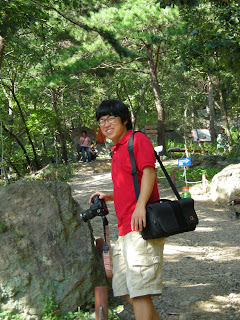
Most of the projects at the Biennale explore how art and construction can blend with natural environments to work symbiotically with them, while planning for the changes that the normal processes of plant growth, decay brought on by the weather, and whatnot will have in transforming their pieces. Alot of it is in the vein of Andrew Goldsworthy stuff.
We had a chance to talk with a dutch artist who made this thing.
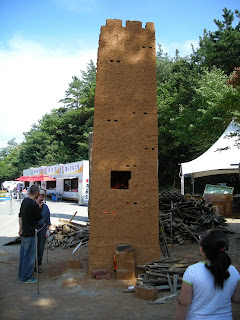
Its a big chimney made from unfired bricks that she is gradually firing from the inside with a months worth of constant fire. Its not doing the job a normal firing process would do, but gradually hardening it up. She said that the work will be interesting for her to see in 3 or 4 years, when the elements have worn down the chimney and the foliage grows up around it to make it a normal addition to the area.
While Korea has a lot of mountains, one of the most amazing things about the whole exhibition is that the mountain is a permanent site for the biennale and these projects will stay up indefinitely after the biennale officially closes in November.
Some other things I really enjoyed looking at: This is a cliff made out of old newspapers.
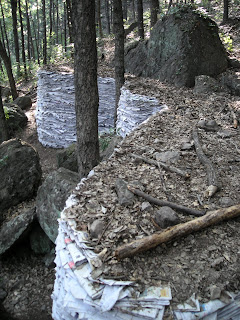
And here is some more of the works, that don't need any more of my comments:
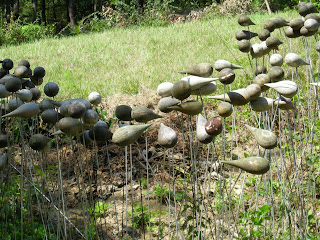
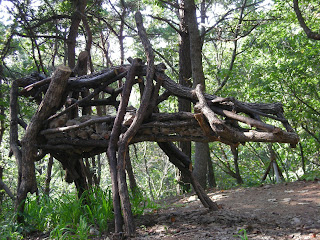

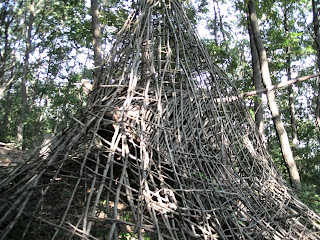

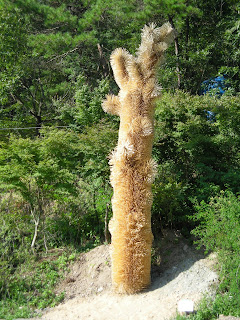

The Geumgang Art Biennale is an art exhibition that takes place every two years on a mountainside in the ancient Baekje capital of Gongju and finds a middleground between these two extremes. You can visit the exhibition's site here. I had a chance to go with two of my friends that I've made here at Geumgang University.
Here is one of the shining stars right here:

Most of the projects at the Biennale explore how art and construction can blend with natural environments to work symbiotically with them, while planning for the changes that the normal processes of plant growth, decay brought on by the weather, and whatnot will have in transforming their pieces. Alot of it is in the vein of Andrew Goldsworthy stuff.
We had a chance to talk with a dutch artist who made this thing.

Its a big chimney made from unfired bricks that she is gradually firing from the inside with a months worth of constant fire. Its not doing the job a normal firing process would do, but gradually hardening it up. She said that the work will be interesting for her to see in 3 or 4 years, when the elements have worn down the chimney and the foliage grows up around it to make it a normal addition to the area.
While Korea has a lot of mountains, one of the most amazing things about the whole exhibition is that the mountain is a permanent site for the biennale and these projects will stay up indefinitely after the biennale officially closes in November.
Some other things I really enjoyed looking at: This is a cliff made out of old newspapers.

And here is some more of the works, that don't need any more of my comments:


Saturday, September 6, 2008
Over Ohio and High Water
After teaching a two week intensive English camp for Fulbright, I returned back to the United States for a 3 week jaunt around the life I left a year ago. Throughout this year I never really thought I would have trouble adjusting back to life in the United States -- doubting I would get the "reverse cultural shock" that everyone seems concerned about on returning -- and, truth be told, I didn't. What I did go through, however, was the strange realization that I have been gone for an entire year from my family, friends, and peers. I'm realizing now that having full interactions with people (ie. speaking the same language and having some common understanding about where each individual is coming from) has helped me throughout life to take a mental note of time while I was living in the United States. Time seems long when there are a lot of these interactions and short if there are few. Without them here in Korea, the past year flew by as if it had only been three months.
Coming home to see how time had changed my family, to hear how diseases have developed or been eased, and how people have gotten married and moved into a much different stage of their life, has made me realize how long I have been gone. But, that is a feeling I would have had even if I was still living in the states, even as close as a state like North Carolina.
All of that aside, it was nice to come back to an environment where I don't have to be as conscious about my etiquette (not that that was a big deal here, but something I did have to pay attention to), to wear my old worn-in clothes, and to eat salads in the grass. My friend Elaina also got me into seeking out wild herbs and greens: my personal favorite being Mullein, which has helped clear up my constantly-blocked sinuses. And I had a chance to go sailing, bike alot, go to a drive-in, catch up with lots of people from in and out of town, and just generally bask in those things that have come to seem genuinely American in their absence.
Coming home to see how time had changed my family, to hear how diseases have developed or been eased, and how people have gotten married and moved into a much different stage of their life, has made me realize how long I have been gone. But, that is a feeling I would have had even if I was still living in the states, even as close as a state like North Carolina.
All of that aside, it was nice to come back to an environment where I don't have to be as conscious about my etiquette (not that that was a big deal here, but something I did have to pay attention to), to wear my old worn-in clothes, and to eat salads in the grass. My friend Elaina also got me into seeking out wild herbs and greens: my personal favorite being Mullein, which has helped clear up my constantly-blocked sinuses. And I had a chance to go sailing, bike alot, go to a drive-in, catch up with lots of people from in and out of town, and just generally bask in those things that have come to seem genuinely American in their absence.
Tuesday, May 13, 2008
Cherry Blossoms

In April the cherry blossoms bloomed and it coincided nicely with voting day, on which most people have the day off from work. I took a car ride with my family to the Gyeryong Mountain where we took these pictures.
Subscribe to:
Posts (Atom)