Thursday, March 27, 2008

Health

Suddenly it is spring and I am back in the country. Since returning to Hongseong and starting school again I've learned that it is Namul -- or wild greens -- season. Koreans believe that the winter slows down your metabolism from lack of activity and that eating wild greens in the spring helps to restore your appetite. My host family's dinner table has been filled with all kinds of interesting greens that are found in the mountains or creek beds and in the afternoon I can often see old women out there picking them to sell at the market. On a recent trip to Cambodia, my homestay parents also invested over $300 dollars in forty-year-old medicinal mushrooms called Sang-Hwang mushrooms (Phellinus Linteus). We now brew the mushrooms at night in a big crock pot and drink the tea in the morning. At least the immediate effects are pretty amazing -- the tea's really calming and dispelled a few big headaches I've had after stressful days with kindergarteners.


Koreans care alot about health. When local media published stories about GMOs and their ubiquity in soybean crops, tofu prices dropped dramatically throughout the country enough so that the government pushed through pretty liberal GMO laws that require products containing GMOs to be labeled. Organic foods -- while they are incredibly expensive here -- are also gaining major ground. This is a small town and even the local grocery store has an organic produce section. And while junk food is gaining quick ground here, people still that I've run into eat fresh food at most meals and reserve junk food for snacking in between. I've grown really interested in traditional medicine here and have been trekking down to the local traditional medicine shop to buy different herbs, mixing them together to see what effect they have (I do research about them first). Possibly unhealthy, but nonetheless an entertaining past-time. My current mix is fo-ti (an herb supposedly drank religiously by a chinese man that lived to be a 130, and renowned for its purported ability to return color to grey hair), Astralagus, and Polygonatum -- both supposed to do a bunch of cool stuff as well. Whatever the case, its a nice tasting blend to drink in the evening that has a vague coffee resemblance. Other herbs that I have been enjoying: Schizandra berry, Goji berry, ginkgo picked from the trees outside my school, cinnamon bark, ginger, licorice root, reishi mushroom, red and white ginseng, and local green tea.


Sunday, January 27, 2008

Jon takes Seoul


The end of January is approaching and I've almost completed one month of living in the second smallest space I've ever lived in at Seoul's premier boarding house, the MAX Livingtel. Because Korea has a very long winter break I have January and February off and moved to Seoul at the beginning of the month to take Korean classes and work an internship come February. I'm living in the college neighborhood of Sinchon and while I have no view of it, or anything for that matter, from my windowless room, the neighborhood's frenetically beautiful, amazing in how much flashy stuff it crowds into such a tight space.


Living here reminds me so much of my freshman year in the college dorms. Like in college, there is a kid who leaves his door open and that I have never seen not wearing pajamas or playing video games. Also like in college, I can hear everything my neighbors do through the walls and even gone beyond that: I can actually feel the shape of my neighbors body when he leans against our common wall!

High points so far:
I visited Sanchon vegetarian restaurant, a buddhist mountain food restaurant run by a retired monk. The restaurant brings you out an enormous meal with dozens of side dishes to share amongst many people as you watch traditional dancing and singing.


I went to an ice festival near the north korean border. The river in the town freezes over and they split it into different sections for ice fishing, ice sledding, ice go-karting, ice sliding, and ice skating.


Trying to figure out the cities music scene and stumbling upon an amazing tribute show for Korean psychedelic singer kim jeong mi. From what I've been able to find on the internet so far, Korea had a pretty strong psych scene in the late 60s and early 70s. I also stumbled into a free improv show that turned out to be some one's birthday party. The place was also a gallery, but instead of the crackers cheese and wine for h'ordeurves they served boiled fish and meat on sticks with hard liquor.

Monday, January 7, 2008

Hustled in Bangkok


Before I describe my own experiences in Bangkok and Thailand, let's first turn to Murrary Head's description in his 1984 hit song "One Night in Bangkok":

Bangkok; oriental city –
But the city don’t know what the city has kept;
The crem de la crem of the chess world in a show with everything, but Yul Brynner.
Time flies -
Doesn’t seem a minute since the Tyrolean spa had the chess-boards in it.
All change –
Don’t you know that when you play at this level, it’s no ordinary venue:
It’s Iceland, or the Phillipines, or Hastings, or… or this place!
One night in Bangkok, and the world’s your oyster!
The bars are temples, but the bills ain’t free.
You’ll find a god in every golden cloister!
And, if you’re lucky, then the god’s a she.
I can feel an angel slidin’ up to me.
One town’s very like another one –
Your head’s down over your pieces, brother.
It’s a drag – it’s a bore to be lookin’ at the board, not lookin’ at the city.
Whaddaya mean?
You’ve seen one crowded, polluted, stinking town…
************
Get tied!
You’re talkin’ to a tourist whose every move’s among the purest.
I get my kicks above the waistline, Sunshine.
One night in Bangkok make a hard man humble!
Not much between despair and ecstasy.
One night in Bangkok, and the tough guys tumble!
Can’t be too careful with your company.
I can feel the devil walkin’ next to me.

Siam’s
Goanna be the witness to the ultimate test of cerebral fitness.
This grips me more than would a muddy old river or reclining Buddah.
Thank God I’m only watching the game – controlling it.
I don’t see you guys waging the kind of mate I’m contemplating.
I’d let you watch - I would invite you,
But the queens we use would not excite you.
So you’d better go back to your bars, your temples
…Your ‘massage’ parlors…
One night in Bangkok, and the world’s your oyster!
The bars are temples, but the bills ain’t free.
You’ll find a god in every golden cloister!
A little fresh, a little history.
I can feel an angel slidin’ up to me.
One night in Bangkok make a hard man humble!
Not much between despair and ecstasy.
One night in Bangkok, and the tough guys tumble!
Can’t be too careful with your company.
I can feel the devil walkin’ next to me.

My friend Tom and I began two days before Christmas --one of the busiest times for Korea-Thailand travel. Plane tickets can be cheap to Thailand and ours were especially cheap because our travel agent routed us through the Taiwanese city of Khaoisung for one night on each leg of the trip. Being someone who likes to cut costs, I thought it was a fine deal and assumed that Tom and I could cut corners even more by sleeping in the Khaoisung airport. American airports may be used to the sight of people strewn in various airport hideaways, waiting for an early morning flight, but Khaoisung was a well-organized city with a very small airport and an even smaller presence of foreigners. So when the security guards saw two dirty foreigners stretched across the floor and seats they didn't know quite what to do. We were asked for our passports and tickets multiple times and shuffled down to customer service and had an interesting evening of all sorts of these random, airport personnel encounters and various gifts given to us along the way, as they thought that we were too poor to get a hotel room. While we only spent 2 nights in the city, Khaoisung itself was a beautifully designed with wide streets, millions of motor bikes,a well-planned grid layout, and a seaside location. Walking around the city made me nostalgic for my trip through China in 2005 and made me remember the polite chaos of Chinese cities. I was very sad that we didn't have more time to spend in Khaoisung and the rest of Taiwan. But, flights are cheap enough that I might make a trip down there sometime in the spring.

Arriving into Bangkok on Christmas Eve was an odd movement between worlds: arriving into an ultra-modern, cephlopod-like airport with hundreds of rich tourists boarding through the most intense entry process I've ever had to go through; driving in a bus along a new highway with football-field-sized billboards and a view over Bangkok's outer-lying slums where people lived in shanties and cooked over outdoor fires; and the seedy tourist area that lies within the boundaries of the old city. Tom and I took a while to find a wonderful guesthouse and within a half an hour of putting our bags down and exploring the town we met the man who would haunt the remainder of our journey: a man we only now know as "the clock man."

He had five or six gold medallions on a chain that resembled clocks at first. and I wondered what a man could need with so many clocks and thought he was a bit suspicious. My next instinct was to figure out if each clock kept track of a different timezone, but later we found out that they are some sort of Buddhist pendants that Thai men occasionally wear. He told us that he was from a teacher in the north, educating the impoverished hill tribes that live outside the city of Chianmai, and that he had come to Bangkok to take a holiday and request more teaching materials from the government. We went to some of the main tourist temples and shrines within the old city together and then, checking another clock on his wrist, the man asked us if we wanted to go and have some Thai food and beer. These sorts of requests have become normal after living in Korea for 6 months and meeting old men on my hiking trips so we said yes and were ushered into a duk-duk (a motorized rickshaw) and driven a ways to an oddly placed bar that was outside of any sort of bar or restaurant district.

We were led into a dingy restaurant where large appliances were being auctioned off in one corner and girls were singing on stage. We were tricked into ordering Thai Brandy that was sold by the bottle and not by the shot and after drinking two bottles of it we discovered that we owed the man 4000 baht each, which totaled around $128. The man was banking on the fact that we didn't know the currency and while we did he, the creepy feeling we got from the restaurant he was probably hustling for, and our tendency to be overly culturally sensitive is what really lost us our money.

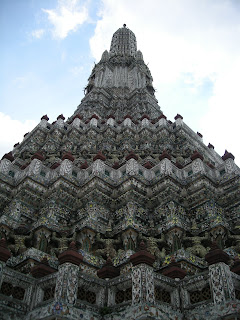
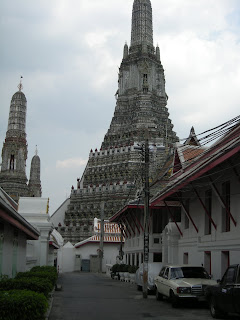
This put a damper on Christmas day but we still toured around the city throughout the day. While it may sound cool that a country has as many Buddhist temples as Thailand does, they lose your attention when you see the same sorts of gold plated shrines on every corner. The Temple of Dawn though was a nice relief from all of this since it hadn't been refurbished recently and had a much different sort of design than the other temples scattered throughout Bangkok.


The night of Christmas day Tom and I rode a 14 hour train to the northern city of Chiang Mai. After dealing with the pollution and traffic-crammed street life of Bangkok, Chiang Mai's slower pace was a much welcomed relief. Much of the foreigner district was within the old city walls crumbling behind a moat that surrounds the city. Chiang Mai is supposed to have the most temples of any city in Thailand and while they grew monotonous just as Bangkok's did, there was something amazing about seeing tiny ones hidden back in street nooks and around bends in the road. Better than this were the make-shift shrines that people built themselves near their homes. And Chiang Mai had so many colossal trees that just rose up alongside these structures and were sometimes 10 of me around.
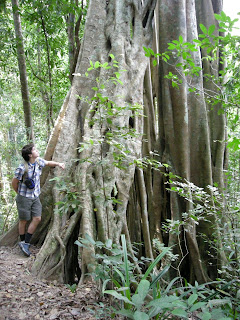


After two days of wandering around the streets Tom and I found my old roommate Brad and his girlfriend Caitlin, who are both doing the JET program in Japan and were also traveling through Thailand and Laos during their winter vacation. We visited a famous temple on a mountaintop with them and then went on a hike through a national park to huge old tree and a waterfall.

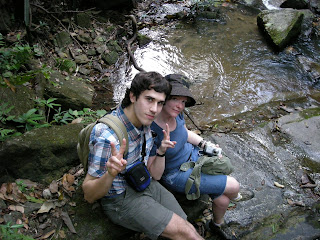
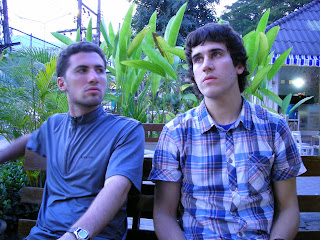


Tom and I took off in a bus through the mountains to the small town of Pai. It turned out to be less Thai and more hippie than anything else we had yet come across. It was bizarre to be seeing tons of falafel stands, watching a bunch of Israelis watch a alien documentary in English, and find more access to western goods than in Korea. This all alongside earthenware pots of boiling herb teas, chickens running around on the streets, and old decaying shrines laid aside in small courtyards off the main road. However interesting it was though, Tom and I both got sick on the bus ride to it and since we had only one night there we didn't get to see very much.

We took a train back to Bangkok and got on the wrong train to the beach, where we had hoped to spend our last day in Thailand. So instead we spent it on the banks of a pond in one of Bangkok's parks. The coolest thing about the place was the number of people doing aerobics in it. We caught our flight back to Taiwan the next day and spent new years eve picking up our baggage as it hit midnight and watched a documentary about a plane crash through the rest of the night.

Tuesday, January 1, 2008

The Taean Oil Spill


As anyone who reads this blog probably already knows, I am horrible at timely updates. Because I've been busy playing santa, getting shots I don't need, sleeping in bathhouses and airports, and being conned in foreign cities, I'm just now sitting down to write about the Taean oil spill.

This you probably already heard about: On December 7 an oil tanker was pierced by a crane-carrying barge off the western coast of the peninsula, causing 10.5 tons of crude oil to escape and blacken 300 kilometers of coastline in Chuncheongnam-do province. The area is renowned for its beauty and diverse ecosystems which support many important bird and fish species. The area also supports a large fishing and tourism industry.

Finally I have a way to describe my location to people living outside the country. When I was traveling this past week I met an Italian man and was trying to describe where I lived in Korea. "Near the oil spill," I said. A conversation that usually lasts 6 sentences was reduced to one and I suddenly realized what useful landmarks disasters can be. South Korea could rename its map with environmental disasters from now on, and with a new proposal by the president to dig a canal connecting Busan and Seoul, there may be a lot to rename in the east of the peninsula over the coming years.

It took a little under a week for the oil spill to wash up on shore and show a visual impact on the coastline. So, I decided to buy some golloshes, hope on a bus on a Saturday morning, and head towards Malipo beach, hoping that I could find a crew to volunteer with.

Mallipo was one of the first areas to be hit and the scene when I got off the bus reminded me of when scientists quarantine Alex's house in ET: white oil-resistant suits everywhere; the streets blocked off with trailers and supply tents; people with clip boards holding down their papers as helicopters descend into make-shift landing pads. Within a minute of stepping off of the bus I was greeted by a volunteer coordinator and ushered off to an area where I could be of some help.

A famous beach and one of the first to be hit by the spill, Mallipo was pretty well cleaned by the time I arrived. Most crude oil had been wiped from the sand and water flowing up through the tides. Gas rainbows still shown almost everywhere though. And worse off were the rocks on the periphery of the main surf, where a black watermark showed where the oil had ascended up the rocks with the tide waters. For 3 hours I blotted gas rainbows until the tides washed up too high to continue working.

I decided to stay another night and was taken in by a group of red cross volunteers who were staying nearby. I shared a room with a kid who is a year older than me and studies Hindi in Seoul. The next morning I went with Red Cross volunteer support crews to help at the nearby beach of Sindori. Far worse off than Malipo, the top of the beach still had solid chunks of crude waste that grew thicker the closer to the water's edge you walked. I spent six hours digging up crude with a hand shovel and despite the small amounts you accomplish by yourself, within those six hours we all cleaned a sizable chunk of that beach.

Its amazing how many Koreans were mobilized by the event and saw it as a national concern. Estimates show that over a half a million people have already showed up to volunteer and the work isn't finished yet. Also included in those numbers was a sizable number of expats who showed up to help.

Tuesday, December 18, 2007

Hitchhiking Notes

This summer I took a trip to Portland, Oregon to spend time with my friend Kate and tour the west coast for the first time. I stayed in Portland for 1 week and then hitchhiked from Portland to San Fransisco over the course of 4 days. I jotted down notes of every person I rode with in between rides and thought that I would type them out on here without revision.

Day 1

PDX-City outskirts: PSU student, red-haired kid, who studied in the Dominican Republic and had the back of his truck crammed with outdoor gear.

City Outskirts -- Salem, Oregon: Hippie-type guy with long black hair and glasses. Stopped to get oil changed and tires rotated. Runs telepathic productions.org and was getting his dog from house in Salem to take to a sitter for his trip. Coming back to join fire crew and then moving to Montreal with his Eugene-based girlfriend. Used to live in Eugene. Lived in Golden Gate Park in Frisco for 2 weeks drinking whiskey and selling drugs, then hitched the 101 back to Eugene or Portland in 4 days in the rain when someone ripped him off and he and his friend had no money to take a bus back. Met guy named dumpster who took him to a punk farm party.

Salem -- Eugene: Record label guy (Romni Records) who had a "build it and they will come" philosophy. Bashed Oregon for being behind and not thinking the same as him. Wanted to explore making custom ipods with musci alrady uploaded. Complained about giving no one giving hitchers rides and how he had to walk a long distance once when he was hitching and no one would pick him up.

Eugene -- Florence: Baptist minister, born in Seattle, who runs a conservative baptist congregation in Florence, Oregon. Also teaches a class at the local high school on life skills. This was the most unexpectedly beautiful ride, pasing through a mountain pass that took us through pools of mist and large fields of flowers and dilapidated farm houses. This is where i saw a large field of purple flowers at sunset with a single person standing in the middle with a red sweater. I think it will stick in my memory for a long time, for some reason.

Day 2

Florence -- Grisam Bay: The type of person I was waiting to meet. Mountain man type guy with a tight mustache and intense "Hook" brown eyes and an intensity/ sincerity to his speech. He was a story-teller who people at his old Alaskan fishing job called "Daddy." Hitched the 101 when he was younger and actually hitched from San Diego to Anchorage in 2 weeks, ended up staying 29 years until his parents recently died. he had just been laid off from a carpentry job -- dubious lay-ff because he had recently been injured -- and there was this underlying tension in the car while he talked to his case worker on the phone and with his son. Lived in a camper in a different town than his wife. Was going crab fishing on this particular day with his son. Told me a story about winning a $100 when he was 8 for filleting a fish in under 10 seconds. Name, I think, was Stanley Kessner.

Grisam -- North Bend: Former trucker named Troy who now takes care fo the local trailer park for his dead mother-in-law. Tattered-looking man who had also hitched as a youth. Went on long tangents about the government and insurance companies and actually dropped me off 8 miles farther than he said he would.

North Bend -- Coos bay: Minnesota man who knew he was going to be laid off and so made plans with his wife to tour the Oregon coast to find a place to live. Started in Astoria and drove all the way south deciding on Coos bay because of the scenery and the cost of buying and fixing up a turn-of-the-century home.

Coos Bay -- Bandin: man named Steven. He had a large but well-groomed beard and a calm, medicated voice. Steven had gone to Reed for Biology and then enrolled in Cornell for his PHD. After speaking with many of the professors researching sodium channels in nerves he realized that he didn't want to be doing this with his life and dropped out. Enrolled in film school at boston University shortly after adn thought that he would like to make ethnography films. Marrying a rich wife, they decided that they wanted to live in east Africa for a while after seeing some souveniers that her parents had brought back from a trip. Steven spent a few months there, in Kenya, doing lots of acid and smoking lots of weed with the holy men there (whose exact name I forget). These holy men believed that if someone took your picture they stole your soul. Steven said that a man had been speared a few months before he had arrived for filming without permission. He realized then how a camera can be a weapon and topped watching movies for years afterwards. He then went on to get his teaching certificate from a college whose name I now forget. he now works for the county health department working on their anti-smoking campaign and earning his master's degree in public health on-line. His son now lives in east africa, moving there on a Fulbright after studying abroad there for many months. His project was seeing whether a butterfly farm would work on a mountain in Kenya. After research he found that it would and built a butterfly co-op that I think the community now runs. his son married a Tanzanian woman and now studies in Atlanta for his masters or PHD. Steven also really liked Peru and was from Massachusetts.

Bandin -- Gold Beach: Older man whose name I unfortunately now forget picked me up. He was originally from Texas, moved to California when he joined the service (and actually went to PGH a few times with a military buddy) and moved to Gold Beach after he finished a career as a park ranger somewhere, i think, outside of the east bay. He gave helpful advice about dealing with black bears, mountain lions, and rattle snakes when sleeping outside. His son is a diabetic and studying to be a nurse in Texas. his parents were some protestant denomination before studying eastern religions and then practicing nothing in old age. He grew up practicing nothing, became a staunch evolutionist in college and then was converted to Jehova's witness after meeting his second wife. I can't begin to summarize the religious conversations we had but they were prompted by me mentioning that I plan to live to be a 110 (he had said you don't really know anything until you turn 40 and I said that I'll have plenty of time to use that knowledge) he said that he plans to live forever through Armagedon. he pointed out helpful camping spots at the end of the ride and came back to bring me a Jehova's Witness book and a Snapple.

Sidenote: That night I was walking back into town after trying to hitch for another 45 minutes. On the way down I ran into this man and woman. The man was 30-40 years older than the woman, with a large white beard and no teeth. He called me "goin' to California" and asked if I had any bud. Then if I had any food -- which I replied I only had nuts -- which he responded by pointing at his teeth, or lack thereof. Then he asked for money and I said that I didn't have much. Before all of this though the man told me that the two of them were leaving their families to start new lives together. She responded that they were kind of free spirits and had no idea where they were going. They also had a dog and carried all of their things -- some pringles, pop, and blankets -- in a red wagon that they pulled behind them. They recommended that I sleep in a laundromat in town that they had slept in the night before. They ended up sleeping about 10 feet from where I had left them when I continued walking into town to get some food.

Gold Beach -- Brookings: Picked up pretty quicly on this one. Man pulled up in a pick-up, having just gone to his lawyer to pay for divorce proceedings. Jeffers complained that his wife had taken in her 23 year old son and when he didn't want him there she filed a restraining order, so he filed for divorce. he worked in the timber mills and said that he may seem a little screw-loose but that I have to realize he came from one of the craziest families. he then pulled out a pistol and said that it was his pedophile killer for his pedophile brother who messed up his arm in the recent past. His brother was actually a pedophile -- charged for raping a young girl and then in the appeal process acquitted because the girl filled out a form wrong or something like that. He went on to tell me that when he was younger he acrewed over $9000 in fines for driving without a license and other mischief. He said he often tried to outrun the cops and sometimes actually did it. He said that he may not know much but that he thought it was ridiculous that they shut down logging in Oregon. That spotted owls had never been around there. He did say that he thinks loggers should evaluate what they are cutting (by species) and be sure to replant them proportionally. He said that this was the problem with the black forest -- lack of diversity made it inhospitable for animals.

Brookings + 3 miles: People that worked at a gospel mission. One originally from Sacramento. Wante dme to come in to eat, sleep, and shower.

Gospel Mission -- Smith River: Hare Krishna guy. Bald with brown bandanna. He lived in an RV and was borrowing a friends truck. He was in the area to begin gold hunting. Currently lived on social security because he told welfare he didn't want to work for the sinful people. Wanted to get a 214 pot license because he said it was worth about $100,000. Growers will pay people with the license to live on their land so that they can legally grow marijuana, supposedly.

Smith River -- Crescent City: Large guy who fished in winter and did cement in summer. he said he made $85,000 on a 4 month fishing trip each year. Used to set up stage for the dead for 18 months and still set up stage for area concerts. Was in the service and was stationed in Japan (which he said was dirty) and Germany (which he loved).

Crescent City -- Crescent City: An old, single man with the most hilarious accent. He was originally from somewhere in the south. He wanted me to stay at his house for a night and said that he would drive me to Eureka when he went to visit his friend in the morning.

Crescent City -- Eureka: Deliver driver who took this route everyday. Had only picked up one other hitchhiker in the last few years and only picked me up because (a) I looked clean (b) he had made all of his delivers and had nothing but diapers in the truck and (c) was going right to Eureka. He played in a jam band that had former members of Grinch (some jam band from the east coast that he claimed was famous). He grew up in Philadelphia/ New Jersey/ Delaware area and attended art school out there. We talked a lot about Meth's impact on the Northwest and he admitted that he had done it a few times during art school to keep him awake enough so that he could finish assignments. He pointed out where the herds of wild elk kept to in the park.

In Eureka: Couldn't find place to sleep so I resorted to putting down $35 on a motel room: I was at the ATM when this girl started talking to me and eventually said that I could stay in her bak yard -- she was going to a party and hadn't warned her mom about visitors. it was a long walk and I was worried that I had laid down in the wrong yard and would have the police called on me because there was no house # labeled. The mother lived in this shed that had been converted in to a room and I guess chose peeing outside over walking back into the house bcause in the middle of the night I was woken by "who the hell are you?" I explained everything and she said that she would have accidently beed on me if I hadn't stirred at the last minute. She turned out to be really cool and invited me inside in the morning to shower and eat.

Eureka -- random truck stop: First woman to pick me up. She gave me a ride about 15 miles down the road to a truck stop. She had been grown up in a self-described "hick family" that didn't follow any religion too much. But she chose within the last year to become a baptized Christian (I forget the denomination, but I think that it didn't really matter much to her). She was a nursing assistant (I think) and worked as a caretaker for an older man (she said she asked God for patience and got patients). Her fiance was raised Buddhist and began attending the same church as her recently.

Random truck stop -- San Francisco: After only about 20 minutes of waiting on the side of the road this two-person band picked me up in an old station wagon they had borrowed form a friend. We listened to the microphones, talked about their first experiences attending anti-war protests and how they thought they would participate in activism in the future. The guy driving, who played drums in the band, had been arrested at his university in Tacoma, Washington for trying to block the transfer of some tanks to boats that were going to transfer them to Iraq. He also enjoyed biking alot. He had grown up in San Diego and the girl riding with him, the guitarist and vocalist of the band, grew up in Portland. They had played a show in Eugene Oregon the night before and were going to San Francisco despite having a show canceled on them, to look for a random club to play in. The guitarist was also meeting her mother there. We stopped in lots of random roadside attractions like "Gravity Hill" which was supposed to be a hill with a weird gravitational pull but turned out to be just a house turned at a weird sideways angle that threw your body off when you walked through it. From San Francisco they were going on to San Diego and then down through the southwest to tour for another two weeks.

Saturday, December 8, 2007

Teacher trip

One morning at school I was told that the teachers were going on a hiking trip together and I still don't actually know where we went.

We left at 7 in the morning and packed 15 or so people into a tour bus that looked to hold around 40 or 50. After riding for a half an hour or so I was told that tour buses are not tour buses in Korea unless they have a no-rai bong (노래방) machine (Korea's version of karoake) and that the government had made laws against dancing in the aisles of moving buses. Soon after the explanation the no-rai bang machine was turned on and the lunch ladies at school began dancing in the aisles of the bus and pulling me and other teachers into the aisles to dance with them.

The mountain we planned to hike was a four-hour ride away from hongseong (the town i'm living in) and we ate twice on the way there, with a little to drink at the second meal. When we got to the mountain I was in disbelief that we were eating again, this time at a restaurant that served mountain mushroom soup and other mountain-specific herbs with alot of macheolli (rice wine). We hiked for about 30 minutes and when I say hike I mean that we walked along a flat path through some historical gates and past some old historical buildings. Even though I still don't know the name of the place we visited, it was a famous path during the joseon dynasty, a mountain pass that students on their way to the national examinations in Seoul had to pass through as they made their way from the southern provinces. The area was beautiful and had high rocky peaks that I was eager to climb, but when we stopped to eat and drink more after only 30 minutes I realized that we probably wouldn't be hiking to the top. The pattern continued and we stopped again another half an hour later to drink some more. The hike ended up being 2-3 hours after a four hour ride each way, and I couldn't stop laughing since I had no idea where we were going the entire time or what we were doing.

On the way home we stopped to eat and drink again and that would be the last of our many stops. I ate a type of miso soup and everyone else ate some kind of meat soup. The next day at school I was asked over and over if I was sore from all the hiking we had done.

Thursday, December 6, 2007

Kim Jong


One of the first lessons I had to teach my high-level students at school was "what will you do this fall." I had only been living with my host family for a week or two and had no idea what there actually was that set Korean falls apart from America's, but I put down "I will make Kimchi this fall" as a phrase to practice, figuring that the dish was eaten so much it had to be made sometime during the fall. I had no idea how much it actually does mark the season here. During November its gotten to the point where piles of cabbage, red pepper bags, and mixing tubs have seemed more like some weird lawn decorations, stacked to all heights along houses or restaurants, than they do actual food staples.

Two Saturdays ago, my host family met with their extended family for Kim Jong (the hangul input on my computer is on a fritz right now, so I can't write the Korean) -- the proper name for making a large batch of cabbage kimchi in the fall. My host mother woke me up early in the morning and we drove to my host father's mother's house, where my host-grandmother cooked breakfast while everyone else gathered together the supplies that would go into the kimchi: red pepper, glutinous rice paste, oil, cabbage, turnips, garlic, green onions, and other odds and ends that I don't know the names of.

After a long process of mixing the red pepper, oil, rice paste, and turnips strips together we all sat on the ground and began to spread the paste all over the cabbage head. Then the cabbage heads were packed tightly into tupperware containers. The whole process took about five or so hours and we went through somewhere between 100-200 heads of cabbage.

Before the advent of refrigerators, greenhouses, and food imporation, Kimchi was one of the few ways for Koreans to get greens through the winters. Traditionally, Kimchi was fermented in large clay pots that you can still see outside of traditional homes, but the smell from the pots coupled with the fact that most koreans now live in large apartment high-rises where space is limited has made Kimchi refrigerators a better option for fermenting the cabbage. The big tupperware containers are put into the kimchi refrigerator and, for our family, the containers will sit in the refrigerator for a year before they are eaten. The refrigerators are specially designed to change temperature and moisture conditions throughout the year depending on the stage of fermentation that the cabbage is in.

Healthwise, Kimchi is great. It has high levels of carotene, absorbic acid, vitamins B1 and B2, and Calcium and Iron. The long fermentation process also provides a lot of bacteria that's beneficial for digestion. The American magazine Health ranked Kimchi on its list of the world's top 5 healthiest foods.

Kimchi's also resurrected a lot of the cultural tensions between Japan and Korea surrounding the Japanese occupation -- and Japan's recent attempt to claim kimchi as a traditional Japanese food, rather than Korean food. You can read about it here